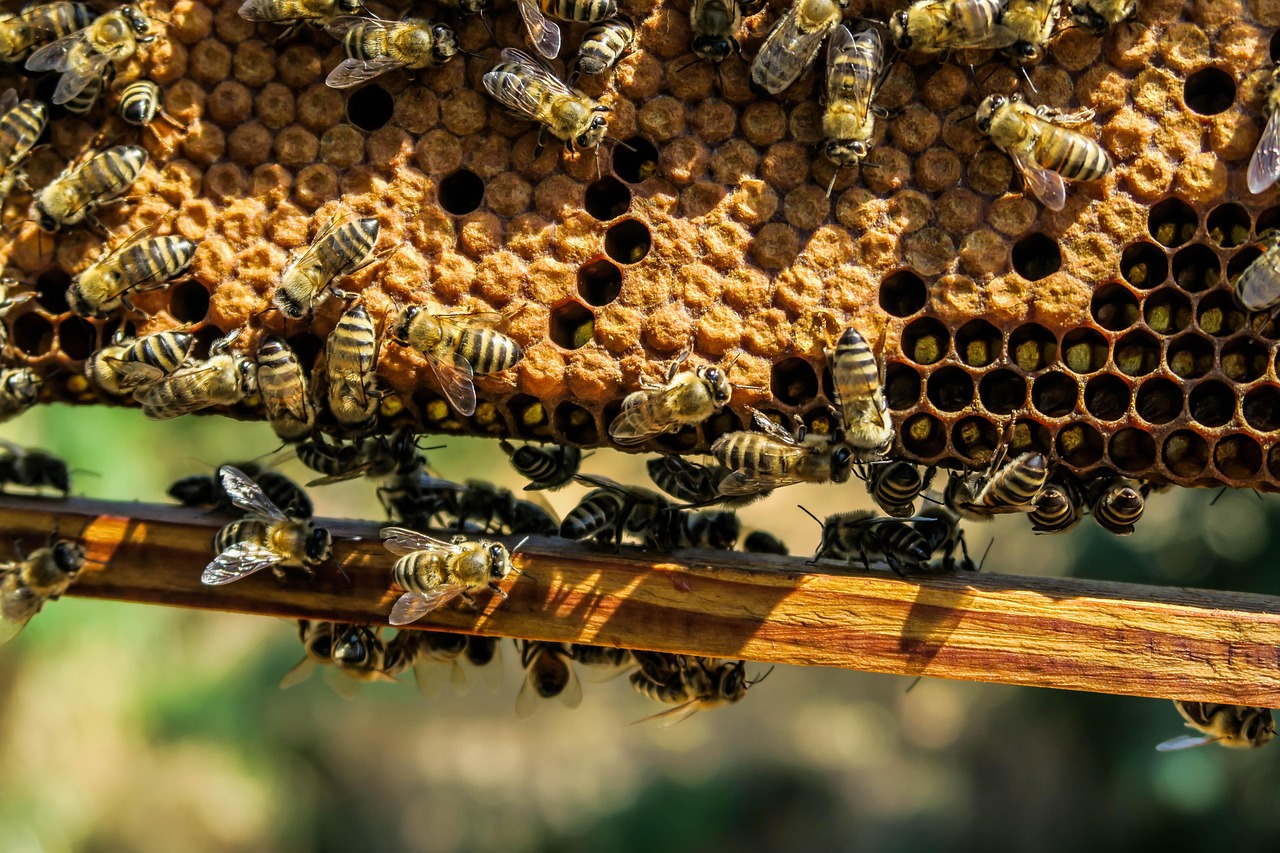
Honeycomb is immediately recognizable, which can make it surprisingly difficult to see. The eye jumps to the familiar hexagon and treats the rest as a uniform pattern. The supplied photographs resist that shortcut. One shows comb suspended above wooden components, crowded with bees and edged by irregular wax. Others move much closer, revealing open cells beside covered regions and colour changing from pale gold to deeper amber. A patient reading begins with the pattern, then looks for every place where the pattern changes.
Structure before story
Start by tracing direction. Cell rows create diagonal rhythms rather than a simple horizontal grid. Their repetition gives the surface coherence, but perspective alters apparent size and shape across the photograph. Near an edge, the wax structure may look less regular. Where bees overlap the cells, only fragments of geometry remain visible. Naming these shifts prevents the comb from becoming a decorative background.
Open and covered cells produce different relations with light. Openings appear darker because the view continues into depth; covered surfaces catch light more broadly and read as flatter patches. The photograph records those visible differences, but it does not automatically explain the contents or history of each cell. A caption can confidently mention openings, pale caps, shadows, and wax texture. More specific interpretation requires context beyond appearance alone.
The hexagon is the organizing rhythm, not the whole composition. Edges, gaps, bodies, and changes of tone carry equal visual weight.
Bees interrupt the grid
A bee crossing comb obscures several cells at once. Many bees create a second pattern over the first: striped abdomens, translucent wings, legs, and varied orientations. Some bodies align with cell rows; others cut across them. In a close view, that overlay communicates occupation more strongly than scale. The comb is not presented as an isolated specimen. It is a surface being traversed.
When describing density, compare visible regions rather than relying on a general impression. One part may be nearly hidden under bees while another exposes broad areas of wax. A dark patch can arise from shadow, deeper colour, open cells, or overlapping bodies. The careful observer keeps those possibilities separate. “Darker area” is often more accurate than a categorical label. Precision sometimes means saying less.
Colour belongs to light
The vertical comb photograph ranges from bright gold to amber and brown. Those transitions contribute to a seasonal feeling, yet a photograph’s colour also depends on illumination, exposure, surrounding surfaces, and the camera’s rendering. It is useful to compare tones within a single image; it is less safe to treat photographs made under different conditions as an exact colour scale. Dovlina’s honey palette is therefore editorial—a way to organize the page—not laboratory data.
Look finally at boundaries. Comb edges reveal thickness and make the repeating surface a physical object. Wood nearby introduces straight, manufactured lines, while wax forms a more irregular contour. The meeting of those materials is central to the visual language of an apiary: built structure supporting an inhabited structure. The photograph does not need imagined action to feel active. Bees are already present, cells alternate in appearance, and the frame contains several kinds of order at once.
A useful field description can follow the same sequence each time: overall orientation, visible boundary, cell pattern, changes in surface, distribution of bees, and qualities of light. Repeating that sequence across images builds comparison without pretending that the frames show the same moment. Comb becomes legible not as one perfect symbol, but as a variable, occupied landscape.