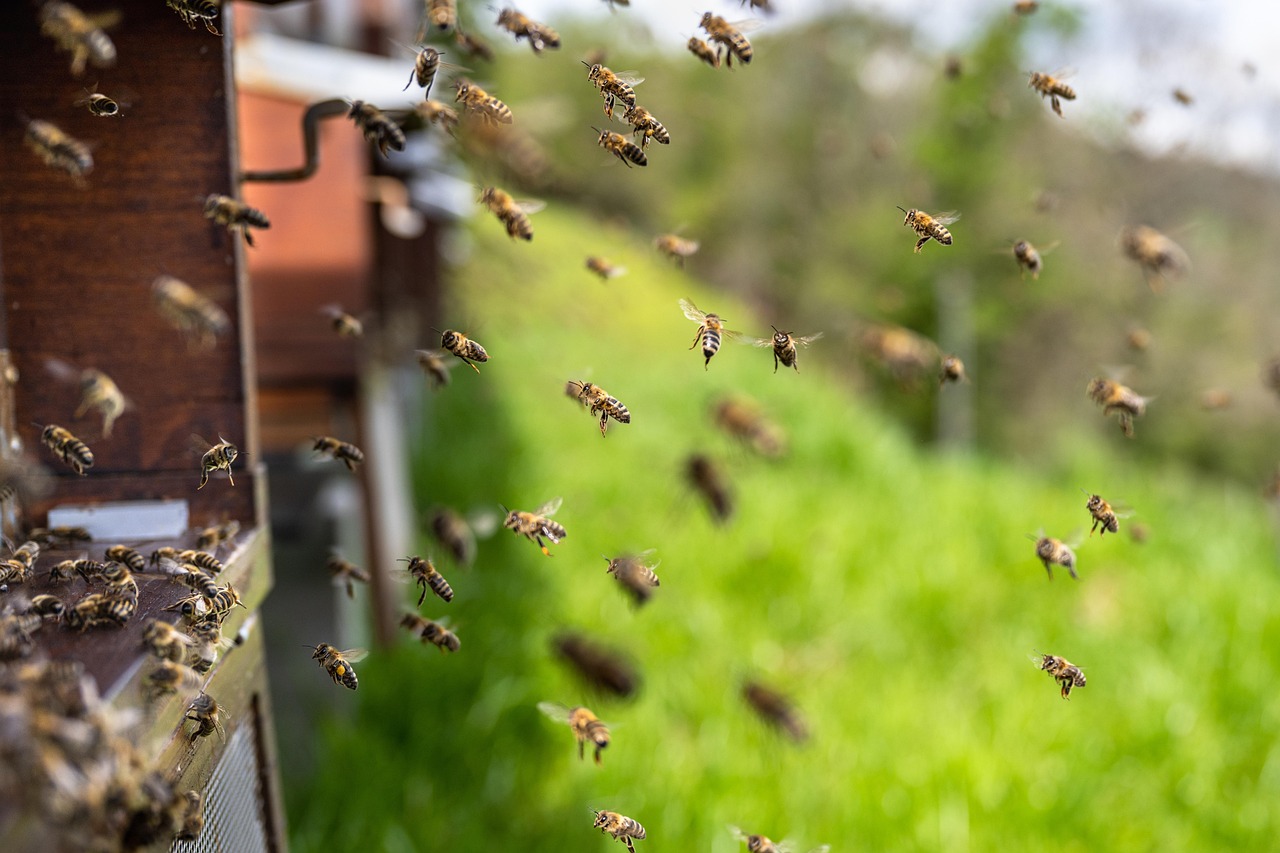
From a distance, a wooden hive reads as architecture: stacked planes, an opening, a dark interior beyond the lip, and a hard edge set against grass. The bees alter that geometry. Some occupy the entrance itself; others appear as small suspended marks in front of it. Because a photograph fixes these positions, it lets us compare the unmoving box with the restless space around it. The contrast is the first lesson of the threshold. Looking carefully does not require turning every visible bee into a claim about the colony. It requires separating what is present from what we infer.
Begin with the frame
First locate the entrance within the whole scene. In the photograph, it sits toward the left, while open grass and blurred vegetation extend around it. That distribution matters. The box provides a stable reference point against which flight becomes visible. Notice which bees are sharply rendered and which are blurred, where the greatest concentration occurs, and how far activity appears to extend from the opening. These are visual observations, not measurements. They create a disciplined description of one captured instant.
Next attend to layers. There is the timber face, the narrow threshold, the nearby ground, and the air in front. Bees overlap all four. A body on the wood has a different visual relationship to the hive than one isolated against green space. The image therefore encourages a reading in depth, even though the photograph itself is flat. Foreground and background help the eye distinguish density from simple overlap.
Watch the interval as closely as the insect: empty space makes direction, concentration, and distance easier to perceive.
Time changes the reading
A single picture offers evidence of presence, location, and appearance. Watching an entrance in person introduces duration. Light moves, wind shifts foliage, and the visible arrangement of bees changes from moment to moment. A responsible field entry should record the date, approximate time, weather, and viewing position before describing activity. Those basic conditions prevent later recollection from becoming more definite than the observation itself.
Short, repeated viewing periods are more useful than one dramatic impression. Write what can be compared: whether the air immediately before the entrance appears sparse or crowded; whether bees are mostly visible on timber, in flight, or on nearby ground; whether activity seems steady during the chosen interval or changes noticeably. Avoid assigning motives to individual movements. Words such as “crossed,” “paused,” “landed,” and “departed” keep a record close to the visible event.
Respect the working distance
The photograph also reminds us that an entrance is active space. Observation should not require blocking it or moving closer merely for spectacle. A position to the side preserves a clear path and produces a more coherent view of the threshold. Clothing, tools, and handling practices belong to trained beekeeping, but this visual guide is about reading an image and forming careful habits of attention—not directing hive work.
Return to the wood at the end. Its grain, edge, and shadow remain comparatively fixed while bees continually redraw the surrounding field. That relationship between structure and motion is why the entrance is such a powerful subject. It makes collective activity visible without revealing the entire interior. The best record accepts that limit. It describes the threshold fully, marks uncertainty plainly, and leaves room for the next observation to differ.