A seasonal journal is an instrument for return. The same place, subject, or type of frame can be viewed again under different light and weather, producing a sequence in which change becomes easier to recognize. The photographs in this issue are not presented as a scientific record of one colony across one documented year. They are separate reviewed images arranged into an editorial cycle. That distinction matters. It lets season shape the act of looking while keeping the claims attached to what each photograph actually shows.
Spring: notice formation
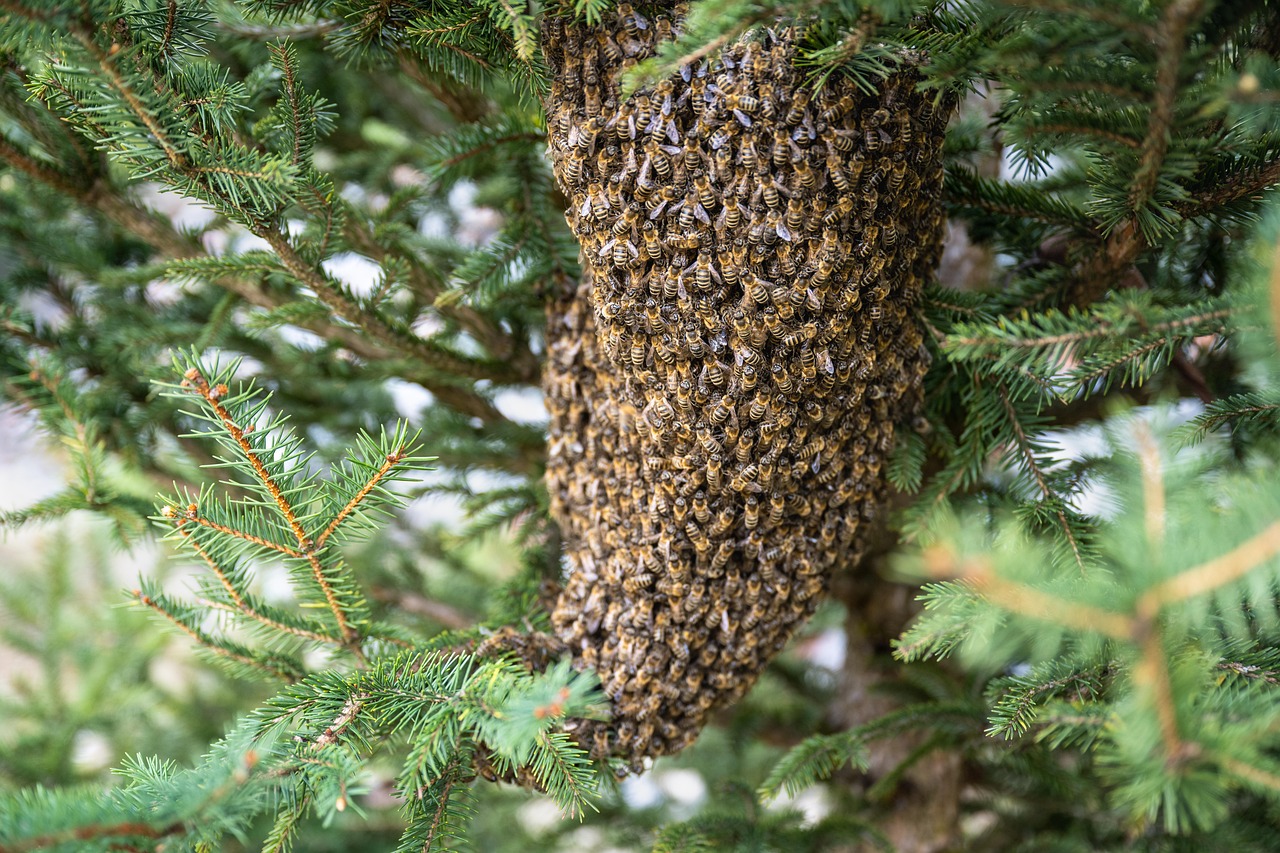
The image of bees gathered among evergreen branches offers a strong silhouette. Individual insects remain visible at the surface, but the first impression is collective: a dark, hanging form with an uneven edge. A spring reading can begin with formation—how many small bodies become one apparent mass, how the branches support the composition, and how green needles establish scale and setting. The image invites questions, but the description need not answer beyond the frame. Record location within the branches, visible density, outline, colour contrast, and the direction of light.
Summer: follow the threshold
At the wooden entrance, the composition opens outward. Bees occupy the box, the nearby air, and space over grass. Summer’s editorial verb is “circulate.” Instead of counting an uncountable instant, notice routes and zones. Where does the image feel most active? Which bodies are sharp enough to show orientation? Where does blur indicate movement or depth? If observing over time, use equal intervals and a consistent position so later entries can be compared more honestly.
A season is not an explanation. It is a recurring appointment with the visible world.
Autumn: compare surfaces
Comb brings the gaze inward. Gold, amber, pale caps, dark openings, and the striped bodies of bees form a dense field of differences. An autumn entry can catalogue material and tone: straight wooden edges versus irregular wax boundaries, open cells beside covered regions, exposed pattern beside areas hidden under bees. Photographs made in different light should not be treated as a calibrated progression of colour. Comparison is still valuable when its limits are written down.
The photograph of honey jars on an outdoor table adds another visible form to the issue’s late-season vocabulary: repeated glass containers filled with golden material, set near garden vegetation and part of hive or extraction equipment. It can be described as an arrangement and harvest scene. Claims about flavour, quantity, origin, or process would exceed the visible evidence, so they remain outside the caption.
Winter: attend to closeness
Macro photographs of densely grouped bees narrow the world to wings, fine hairs, legs, and abdominal stripes. Winter’s useful practice is concentration. Scan the frame slowly from one edge to the other. Notice overlapping transparent wings, changes in focus, the direction of bodies, and tiny gaps where the surface beneath becomes visible. Density does not erase variation; it makes deliberate looking more necessary.
A year-long notebook benefits from a stable template. Include date, time, general weather, viewing distance, image or subject, and a short paragraph restricted to visible facts. Follow with a clearly marked interpretation or question. This separation is simple but powerful: it preserves uncertainty and makes later comparison more trustworthy. Add a sketch of spatial relationships if words begin to flatten the scene.
At the end of a cycle, review entries horizontally rather than searching for a dramatic conclusion. Which visual features recur? Which conditions changed? Which words were too vague to support comparison? The value of four seasons lies in accumulated attention. A hive, comb surface, bee cluster, or row of jars can be familiar and still resist summary. Returning teaches the observer to see that resistance not as failure, but as the beginning of a more exact record.